DJ School Nederland
Turning Audience Insights into a Research-Driven Content Strategy
Project Overview
DJ School Nederland is a Dutch music education provider offering professional DJ and music production training.As part of my Master's in Content & Media Strategy at NHL Stenden University of Applied Sciences, I worked on a strategic content development project for the school.The project combined audience research, customer journey mapping, competitive analysis, content auditing and creative development to identify opportunities for improving the school's digital communication.The challenge was to move beyond simply promoting lessons and build a content approach that connects with aspiring DJs, communicates the school's expertise and creates stronger relationships with prospective students.
This is a title
01 — Audience Research & Customer Insights
Turning primary research into actionable insights.
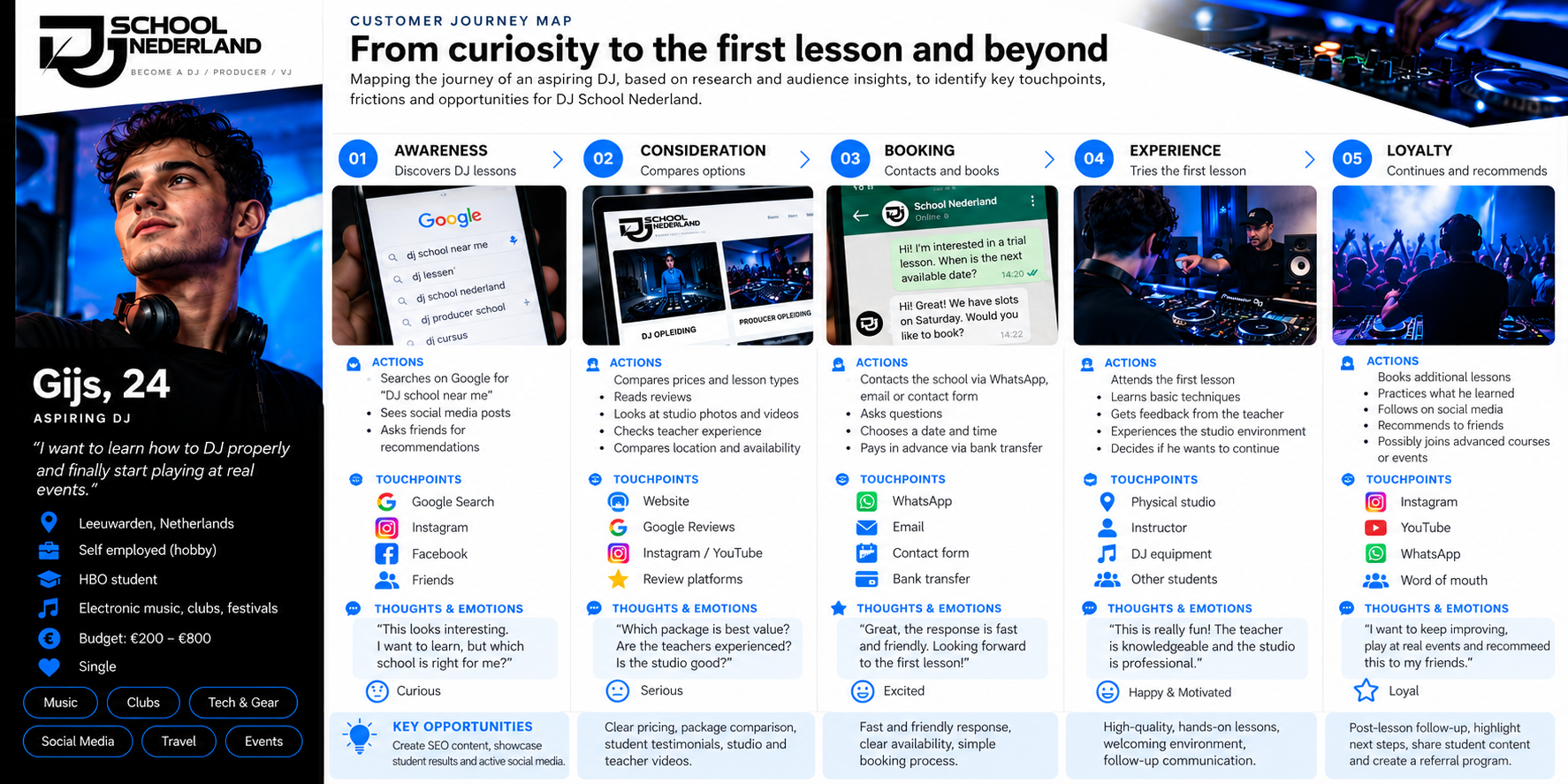
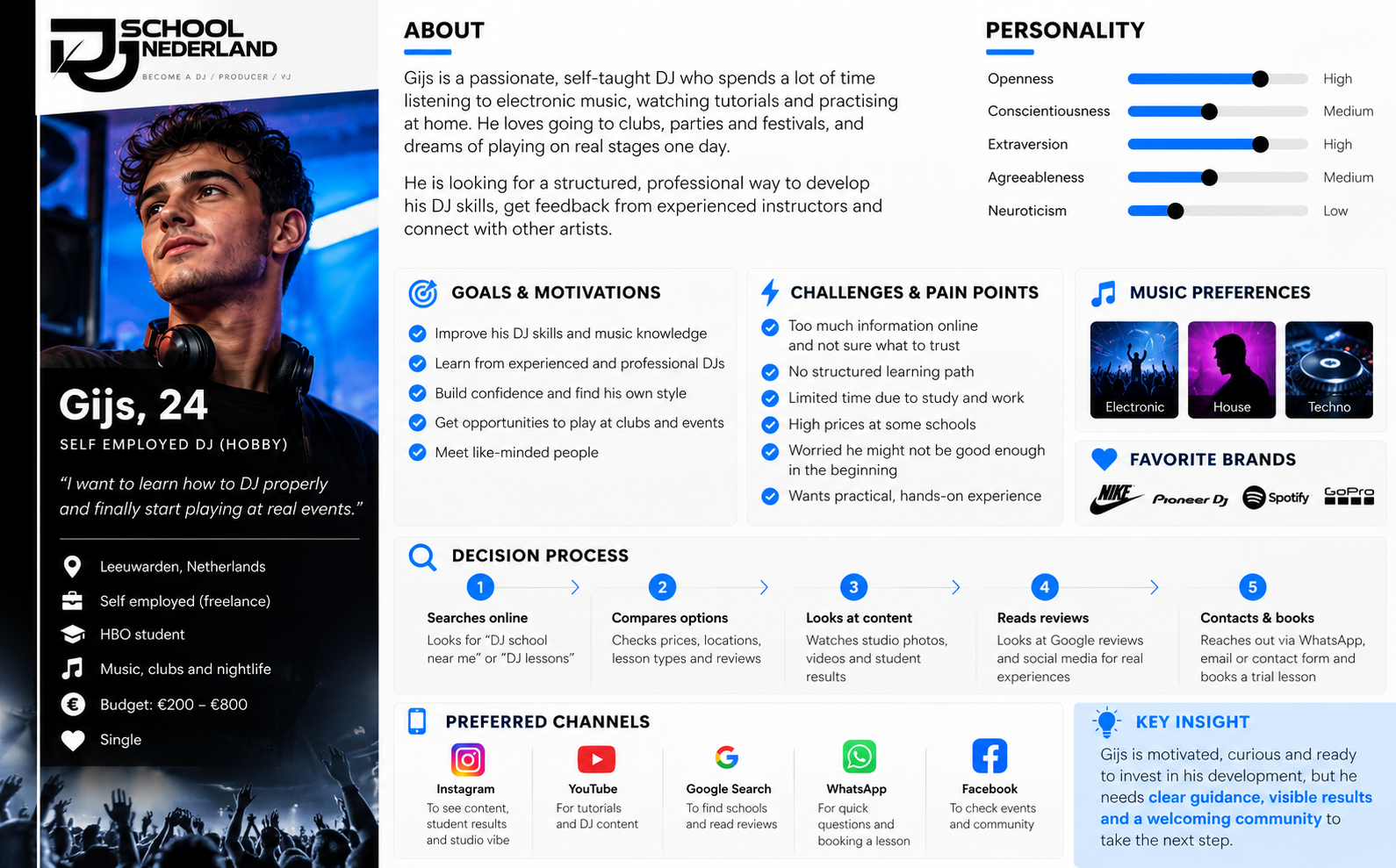
To understand DJ School Nederland’s target audience, I conducted qualitative interviews and questionnaire research to explore prospective students’ motivations, expectations, challenges and decision-making behaviors.
Research Methodology
- Qualitative interviews: Explored audience motivations, learning expectations and barriers.
- Questionnaire research: Collected structured data on preferences, interests and attitudes toward DJ education.
- Data analysis and clustering: Analyzed responses and grouped similar characteristics and motivations into audience segments.
- Audience personas: Translated research findings into representative customer profiles.
- Customer journey mapping: Identified actions, touchpoints and pain points from awareness through loyalty.
Key Research Insights
Prospective students valued practical learning, experienced instructors and personalized guidance. Pricing, location, lesson quality and recommendations were important considerations when choosing a school.
From Research to Strategy
The audience segments, personas and journey maps informed the content strategy, helping identify communication gaps, prioritize relevant topics and develop creative concepts grounded in customer needs.
02 — Content Audit & Competitive Analysis
Identifying performance gaps and opportunities for improvement.
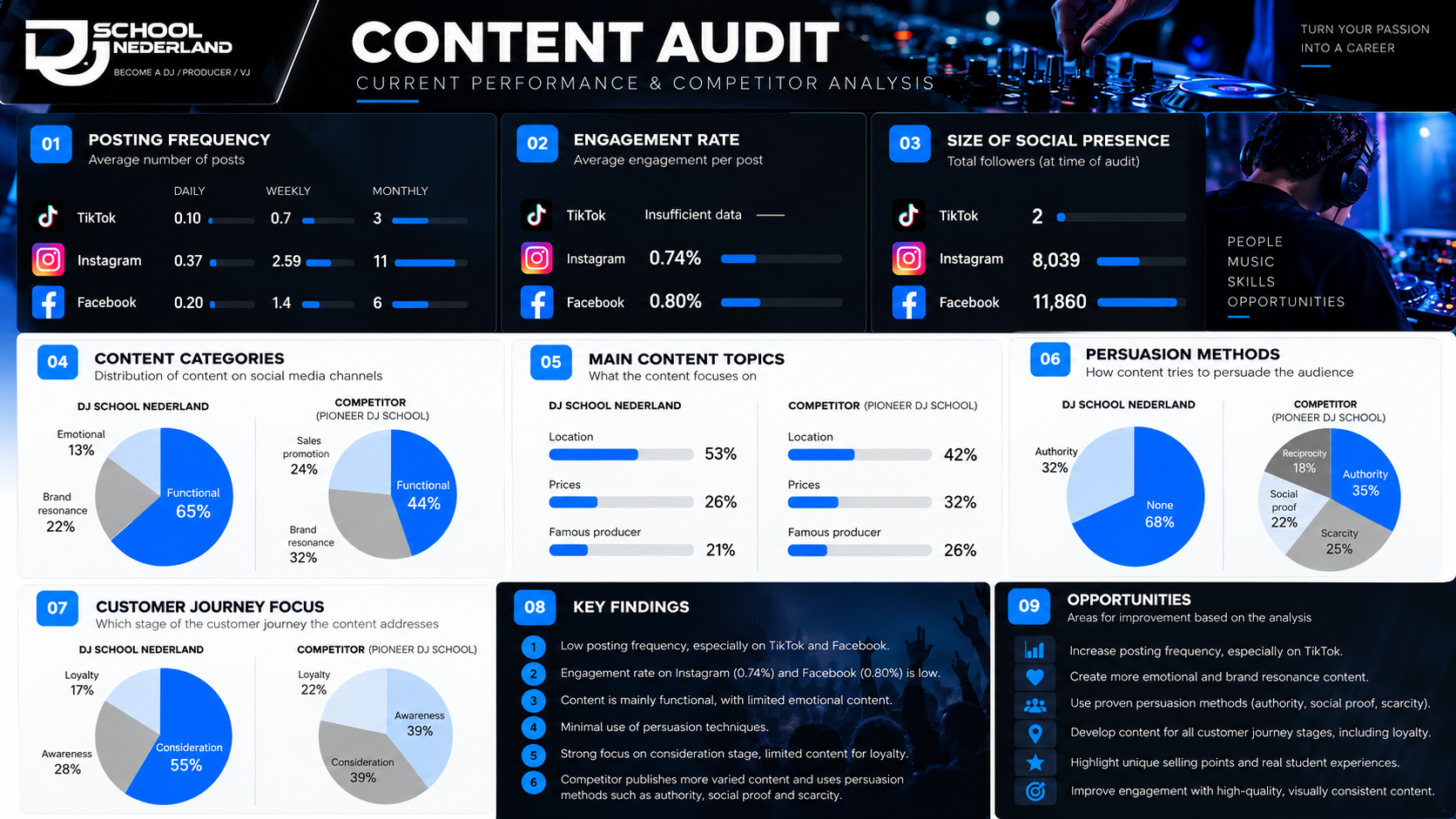
I conducted a comprehensive social media content audit of DJ School Nederland, comparing its digital communication with competitor Pioneer DJ School.
The analysis examined publishing frequency, engagement rates, audience size, content categories, persuasion techniques, and the customer journey stages addressed by existing content.
Content Performance
The historical audit revealed several areas requiring attention:
- Instagram engagement: 0.74% average engagement rate, with approximately 11 posts per month.
- Facebook engagement: 0.80% average engagement rate, with approximately 6 posts per month.
- TikTok activity: Approximately 3 posts per month, with insufficient engagement data.
- Content distribution: 65% functional content, 22% brand resonance and 13% emotional content.
- Customer journey focus: 55% of analyzed content targeted the consideration stage.
Competitive Benchmarking
Comparing DJ School Nederland with Pioneer DJ School revealed meaningful differences in their approaches to content marketing.
The competitor demonstrated a more varied content mix, with 44% functional content, 32% brand resonance and 24% sales promotion. Its communication also incorporated a broader range of persuasion techniques, including authority, social proof and scarcity.
Key Findings
- Inconsistent publishing frequency limited opportunities for consistent audience engagement.
- Content focused heavily on practical information, with fewer emotional and community-driven stories.
- Limited use of social proof and persuasive messaging presented opportunities to strengthen credibility.
- Existing content concentrated on consideration, leaving opportunities to strengthen awareness and loyalty communications.
Strategic Implications
The findings highlighted opportunities to develop a more balanced, audience-focused content strategy through consistent publishing, authentic student experiences, practical educational content and stronger brand storytelling.
These insights became an important foundation for the subsequent content strategy, message architecture and creative development.
Data reflects the original 2022 research period and represents the historical audit baseline, not current social media performance.
03 — Strategic Direction & Brand Messaging
Connecting audience needs with brand strengths to create a focused content strategy.
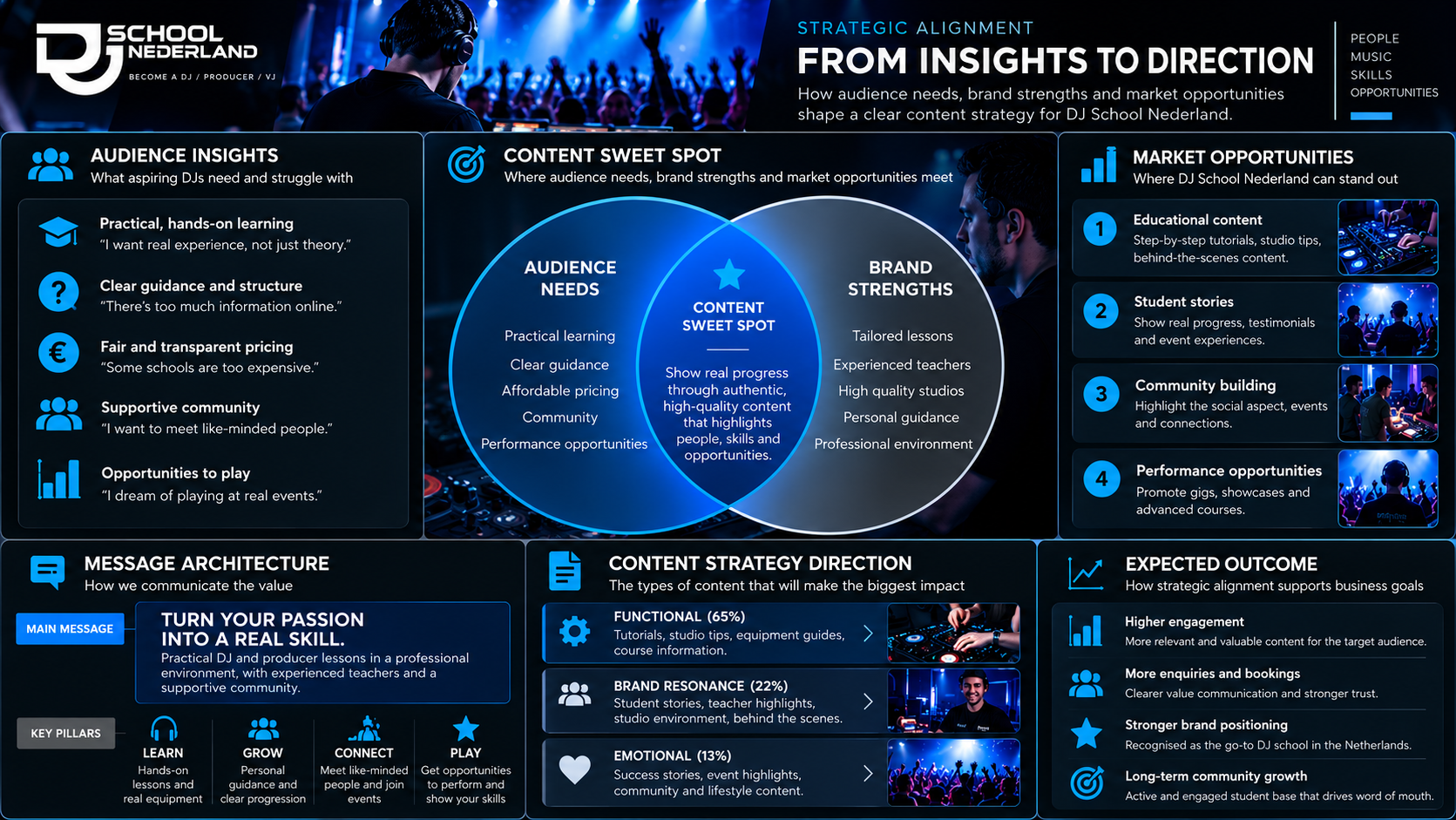
Using the findings from audience research, customer journey mapping and competitive analysis, I developed a strategic direction designed to strengthen DJ School Nederland’s positioning and make its value more visible to prospective students.
Finding the Content Sweet Spot
The strategic approach focused on aligning three important elements:
- Audience needs: Practical training, experienced instructors, personalized guidance, clear pricing information and opportunities to develop musical skills.
- Brand strengths: Tailored lessons, professional studios, experienced teachers and an individual approach to learning.
- Market opportunities: Greater use of authentic storytelling, educational content, student experiences and persuasive communication.
This alignment highlighted an opportunity to communicate not only what the school offers, but also the personal development and experiences students can gain through its lessons.
Core Brand Message
Turn Your Passion Into a Real Skill.
This portfolio-facing creative message captures the recommended positioning: helping aspiring DJs and music producers develop practical skills through professional instruction, personalized guidance and a supportive learning environment.
Content Pillars
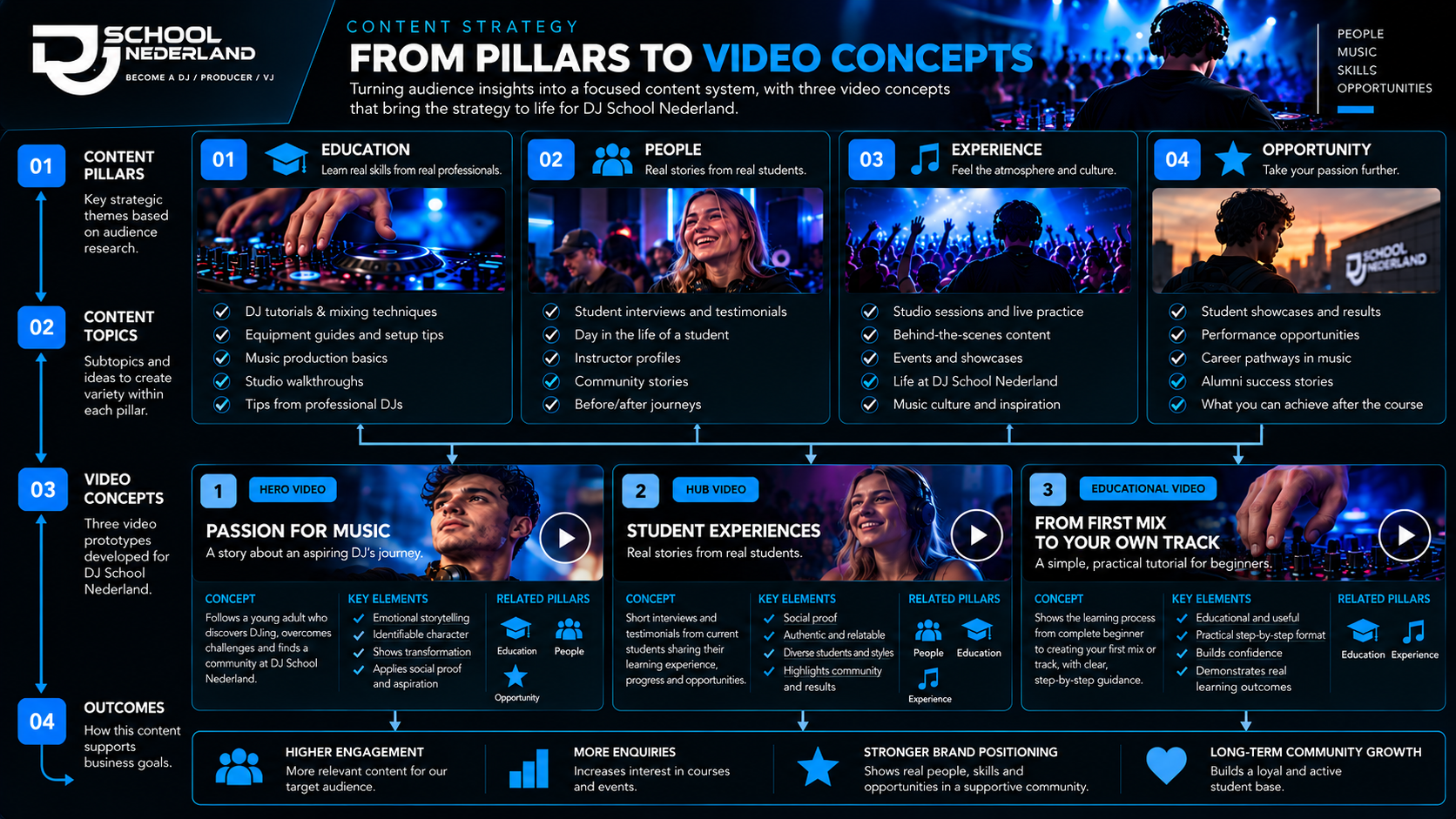
For this portfolio presentation, the strategic recommendations have been organized into four interconnected content pillars:
- Education: Practical tutorials, mixing techniques, music production basics, equipment guides and professional tips.
- People: Student journeys, instructor profiles, testimonials and community experiences that build trust and credibility.
- Experience: Behind-the-scenes studio content, practical lessons, music culture and events that communicate the learning environment.
- Opportunity: Student progress, showcases, performance aspirations and possibilities for further skill development.
Message Architecture
The communication approach emphasized four complementary messages:
- Learn: Develop real skills through hands-on training and professional equipment.
- Grow: Build confidence through experienced teachers and personalized guidance.
- Connect: Become part of a community of people who share a passion for music.
- Play: Work toward personal musical goals and potential performance opportunities.
Strategic Outcome
The resulting direction provided a foundation for developing more relevant and consistent content across social media channels.
By combining educational value, authentic student stories and emotional storytelling, the strategy aimed to strengthen audience engagement, build trust and encourage prospective students to explore the school’s courses.